The High Cost of Hesitation: Why Businesses Without AI-Driven Decision Making Are Falling Behind
The High Cost of Hesitation: Why Businesses Without AI-Driven Decision Making Are Falling Behind
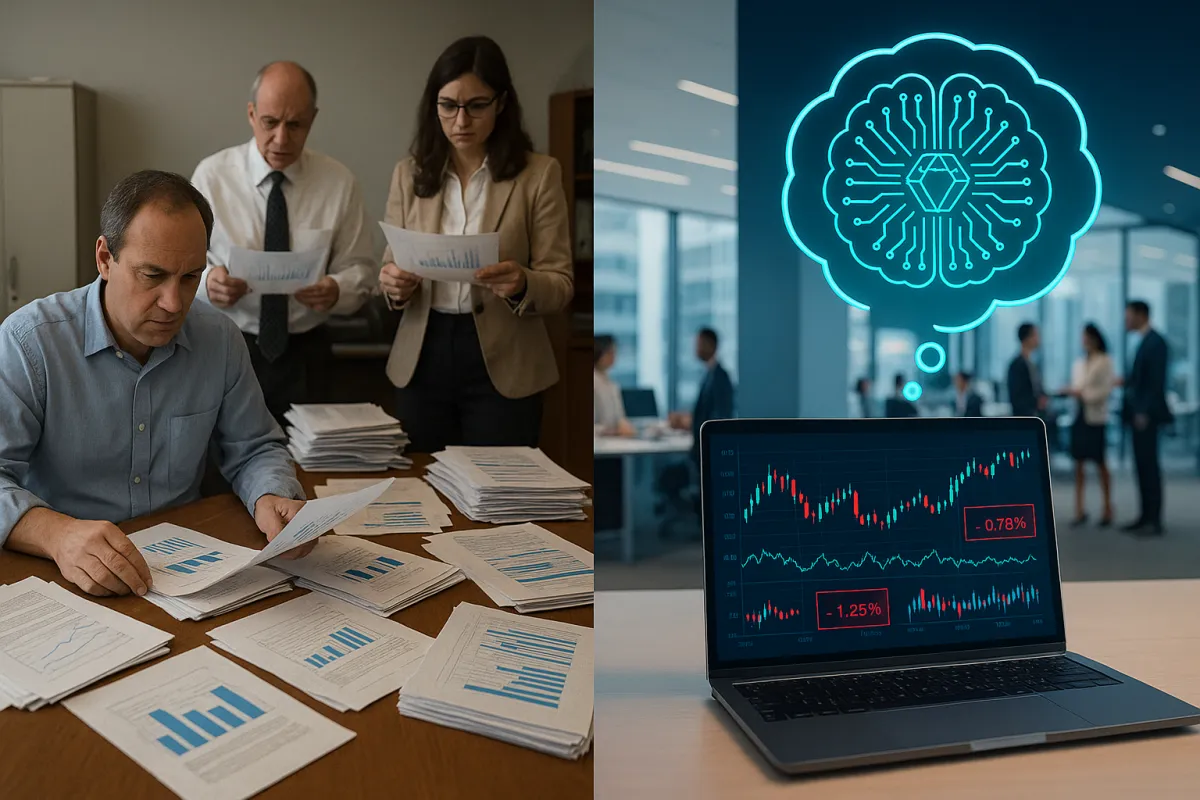
Things are moving fast in business across market segments, and commercially available artificial intelligence (AI) has advanced from curious explorations of what's possible into a fundamental necessity for strategic advantages. Yet, many organizations still to rely tried and true decision-making methods from human-based institutional knowledge, to using the same general use large language models the public turns to basic information needs . These companies are fighting the war for the business’s future with the weapons of yesterday. The consequences of hesitation to adopt AI specific to your strategy decisions are becoming increasingly severe.
The Growing Decision-Making Gap
Businesses with no AI capabilities find themselves making critical decisions based on incomplete information, gut feelings, and outdated reports. While some companies leverage basic AI models like ChatGPT, Grok, Gemini, and Claude to process data and generate insights, their failure to implement secure AI built for business leaves them lagging behind companies that have. The gap between a company using the same AI a high schooler uses for their homework and another with a dedicated business LLM trained on business intelligence is widening at an accelerating pace for multiple reasons.
1.Slower Response Times in Fast-Moving Markets
Markets are moving at unprecedented speeds with sometimes unpredictable volatility. Consumer preferences shift overnight, supply chains face unexpected disruptions, and competitors launch new strategic initiatives without warning. Traditional quarterly reports and monthly reviews simply can't keep pace. By the time internal company data is collected and analyzed, external market forces are scrutinized, and everything is presented to decision-makers in the big meeting, the window of opportunity has often closed. Companies need speed and the capability to process multiple decision sets using real time data. AI-driven business analytics often discover these market changes weeks or months before they occur, well before it’s too late to respond effectively.
2.Hidden Patterns Remain Hidden
Human analysts, no matter how skilled, can only process limited amounts of data and identify obvious patterns. AI with business focused reasoning excels at uncovering subtle correlations and trends buried within massive datasets. These critical insights could reveal:
Emerging customer segments before they become obvious
Early warning signs of employee turnover
Supply chain vulnerabilities before they cause disruptions
Pricing optimization opportunities worth millions
Without business focused AI, these valuable insights remain invisible, representing lost revenue, continuing inefficiency, and missed opportunities that never even appear on the radar. Uncovering hidden patterns like these can be the difference in your company’s competitive edge.

3.Bias and Inconsistency in Decision-Making
Human decision-making, while valuable, is inherently subject to cognitive biases, confirmation bias, recency bias, and anchoring effects, among others. The people on our teams can be swayed by:
The most recent information rather than comprehensive trends
The loudest voice in the room rather than the strongest evidence
Personal preferences rather than market realities
Anecdotal experiences rather than statistical significance
These biases compound over time, leading organizations down paths that “feel” right but are laced with emotion versus being driven by data. Emotional decisions based on gut feelings or reflecting capitulation from bolder voices leads to suboptimal outcomes. AI trained on business decision-making will have an inherent bias to provide objective, data-driven recommendations, to better inform cost cutting, profitable strategic decisions.
4.Competitive Disadvantage That Compounds
Perhaps the most concerning issue with slow adoption of strategic business AI is the compounding nature of not adopting. When competitors use AI to:
Optimize pricing dynamically
Personalize customer experiences at scale
Predict and prevent operational issues
Enhance marketing outreach to maximize sales
Allocate resources more efficiently
They gain more than a one-time advantage, they create a virtuous cycle of better decisions leading to better outcomes. Their cycle generates generate better data, which enable even better decisions. Meanwhile, companies without business focused AI find themselves in a swirl of poor decision making, perpetually swimming up current to play catch-up, while initiatives that should work somehow swirl down the tubes in failure.
5.Scaling Challenges
As the business grows, decision complexity increases exponentially. A company with 4 products, 2 markets, and 2 distribution channels faces16 possible combinations to optimize. When that same organization grows to 10 products, 5 markets, and 3 distribution channels it faces 150 possible combinations needing data-driven insights. Adding more variables like unique customer segments, various pricing tiers, complex promotional strategies and the complexity become impossible for humans to analyze alone.
Business driven AI systems thrive at the center of this complexity, identifying optimal strategies from deep reconnaissance across thousands or millions of scenarios. Without AI, growing companies often respond by oversimplifying their strategies or making decisions based on incomplete analysis. Both of these and more put an anchor on the company’s growth potential.
6.Talent Acquisition and Retention Issues
Top talent, particularly younger professionals, increasingly expect to work with cutting-edge tools and technologies. Young people today are digital natives, having grown up with devices in their hand, tech at their finger tips, and they don’t want to work the way prior generations used to. Companies relying on archaic spreadsheets and manual analysis struggle to attract and retain the best strategic thinkers, who gravitate toward organizations where their skills are amplified by AI capabilities.
I hope you can see this creates another compounding problem: the best people go to companies with the best tools, widening the capability gap even further.
7.Risk Management Blind Spots
Modern business environments are filled with interconnected risks that are difficult for humans to fully grasp. AI systems built for business can:
Monitor thousands of risk indicators simultaneously
Model complex scenarios and their cascading effects
Identify emerging risks before they materialize
Quantify risk exposure with greater precision
Create risk mitigation plans for swift action
Without these capabilities, companies operate with significant blind spots, often discovering risks only when they've already caused damage.

What You Should Do
The good news is that implementing AI for strategic decision-making doesn't require a complete organizational overhaul. Companies can start small:
Identify high-impact decision points: Areas where better insights would create significant value and apply strategic business focused AI.
Start with augmentation, not replacement: Don’t think of replacing your human team, examine how to make your human decision-makers better informed and more efficient.
Build data infrastructure: Refine your data into facts that makes AI implementation possible
Develop AI literacy: Find or create AI champions in your organization and empower them to educate and evangelize for the technology to proliferate through your org.
Partner with AI providers: If you want to go fast, go alone. If you want to go far, partner with professionals dedicated to your success instead of building everything in-house
Core Insight
The question is no longer whether to implement AI for strategic decision-making, but how quickly you can do so. Every quarter without AI-driven insights is a quarter where competitors pull further ahead, opportunities slip away unnoticed, and risks accumulate in blind spots you’ll wish you had seen.
The businesses that will thrive in the next 5 years won't be those with the most data or the smartest people, they'll be those who most effectively combine human judgment with business focused AI-powered insights. The time to start that journey is now.
So, what challenges has your organization faced in implementing AI for decision-making? Share your experiences in the comments so we can all learn together. Adaptive Intel is here to help!